Search

Shanghai Pathways Blog

Understand ​China​ ​From the Local ​Perspect​ive

Author

Janny Chyn

Janny Chyn is the founder of Shanghai Pathways (www.shanghaipathways.com), a platform that engages people to learn and understand the city through unique cultural activities “off the beaten tracks.” She is also a writer for The Courier magazine and has been a guest speaker for schools and organizations. Apart from running Shanghai Pathways, Janny provides training and consultation service for corporate clients such as P&G, Ipsos and Google. Her current work has been featured in media outlets including Los Angeles Times, Miami Herald, CNNgo, The Sacramento Bee, Zester Daily, Nomadic Notes, Business Mirror, Shanghai Morning Post, Daily Secret.

Lost by director Zhou Xiaowen

Shenzhen, China, the present day. Nineteen-year-old Wang Baihe (Wang Zitong) is a migrant worker from a village in Shaanxi province. She has a baby son from a one-night stand with a man from Hong Kong and a small income from making Chinese decorative knots at home. Her dream is to open a noodle restaurant and “make lots of money and become a city person” but she finds it difficult to find regular employment because of her baby boy. Her story emerges through interviews with journalist Liu Nan (Lü Liping), who is writing a book about her. When Baihe discovers her son has congenital heart disease, she tries desperate ways to raise the RMB80,000 (US$12,000) for the operation, helped by her friend and fellow migrant worker Hu Jinling (Zhao Yaqi). 

Excavate the issue of humanity

At the moment,  four types of films prosper more so than others within the current context of the Chinese film market: patriotic “red” movies, crime thrillers, action movies and romance stories. There are few films that truly concern common people and disadvantaged groups such as women and children. Sometimes I wonder if there will be a situation where these movies disappear altogether.

Eating bitterness

China is now experiencing the fastest economic growth in recorded history. Little known however is the fact that millions of young women from poverty-stricken areas have migrated to the more developed coastal regions trying to make it in the cities. Many of them have to endure all kinds of miseries and humiliations in order to live better lives. Some of them become rich men’s mistresses while others work 16 hours a day at the cost of their health. There are also a great number of them who become single mothers. The population of such single mothers has reached three hundred thousand and the number is still growing.

Though intimate in its portrayal of a village girl’s yearnings for success in the big city despite her increasingly dire social circumstances, Lost (Baihe) offers a thought-provoking case study that suggests that this is not just the story of one fictional woman, but of a vast (and largely unspoken) cross-section of modern Chinese society.

Here is a better idea: Chinese official government estimates put migrant workers in China at 221 million (16.5 % of the total population) and expected to grow another 100 million over the next 10 years.

There, but for the grace of God

Watching this movie, I can’t help but think that this could happen to me or just any person. We are who we are because of where we are, when we are born and who we know. In the end of the movie, we have 3 totally different endings and all seems true and highly possible.

Hunting for Congyoubing

A cong you bing or green onion pancake is a savoury, non-leavened flatbread folded with oil and minced scallions(green onions).  It is crispy and doughy, with layers of fragrant spring onion that are at once salty and sweetly caramelised. The trick to cooking this is in the creation of paper-thin layers, sprinkled with finely sliced spring onion and salt. Whilst the outside crisps and browns from its contact with the oil, the layers fill with steam and cook the bing from the inside out, giving it that perfect consistency of crunch, chew and moisture.

The Chinese Legend

There is a legend in China that pizza is an evolution of green onion pancake, brought back to Italy by Marco Polo. Here is one version of the legend:

Marco Polo missed green onion pancakes so much that when he was back in Italy, he tried to find chefs willing to make the pancake for him. One day, he managed to meet a chef from Naples at a friend’s dinner party and persuaded him to try recreating the dish. After half a day without success, Marco Polo suggested the filling be put at the top rather than inside the dough. The change, by chance, created a dish praised by everyone at the party. The chefs returned to Naples and improvised by adding cheese and other ingredients and formed today’s pizza.

Follow the Smell

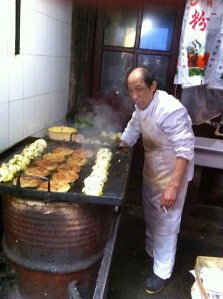
At  the corner of Maoming road Nanchang road in Shanghai, there is a famous street food stall, locally known as the A Da Congyoubing. Each congyoubing cost RMB3, it is actually the most expensive bing in Shanghai, usually it only cost RMB1 or 2. I guess quality comes with a price.

A Da, the congyoubing master only makes 300 bings every day and it takes 20 minutes to make 10 each time. So you will need to learn to be patient to wait for at least 1 hour as the line is just so long.

My special hunting trip for congyoubing was really funny. Since I am so lazy and slow in the morning, I have to camp at my friend’s place nearby the market to make sure I could arrive there by 7:30am, and then I promised my mom that I will bring home 10 bings for her as she did wonder why it is so special.  Actually, I have been planning this for weeks, everyone around me has been waiting for their share of the best cong you bing.

When the finally time arrives, the funny thing happened, A Da decided to have his day off on Wed…..so my effort went in vain and I had to find something else for my empty stomach – bad luck!!!

C’est la vie ~ life sometimes feels like a joke.

The Rich Hunchback Guy

A Da is his nick name – in Chinese it means big brother. He is really a strange looking guy, when he was young, he hurt his back and that’s how he become a hunchback. Since he is disabled, he could not find good job and so he spent RMB20 which was a lot of money at the old time to learn how to make congyoubing. Later he has been selling congyoubing to make a living for over 30 years. Now at the age of almost 60, he has provided his son a good life and bought 3 downtown apartments in Shanghai’s French concession.

In short, he is a millionare now and does not need to work hard and make congyoubing any more. So what makes him get up everyday at 4am and finish by 2pm? A passion for his food, I guess.

At his spare time, he love to sing songs and smoke 😉 After 10 years, he said that he will retire and travel around the world. But he is worried that no body will make congyoubing like he does any more.

The Afterwards Story

After my failed attempt, I have been receiving reports from friends about their experience with the congyoubing:

Nat – the chef: I went to the cong you bing place the other day. Waited 1.5hrs! They are certainly very good, but not worth waiting so long. I bought six and can report that they heat up pretty well for breakfast the next day.

Bobbie – my friend: It is so so so good! His cash register is an honor system, self pay and make your own change system. Amazing thing to contemplate is that his stove looks like a half barrel. It looks like he has gas tanks that run into the barrel. He knows his stove perfectly – how to regulate the heat, which are the hotter and cooler parts, how long to keep each congyoubing in which part of the grill. He measures nothing, but each congyoubing is perfectly shaped with a uniform size. He puts the first ones in the middle and knows how long each side gets and how hard and how often to press them. After the ones in the middle are just right, he moves them over to the edge to finish and puts new ones in the middle. The kitchen he cooks in is his kitchen. When you go up to take his picture, he smiles and says “ni hao”… He does not like for people to buy and then resell. He only makes 10-20 at a time. Many people who wait in line buy all 20 to take to family or colleagues in the offices they work in.

Chinese Umbrella

Perhaps I was born as the kind of person to save the Chinese umbrella industry. It is embarrassing to admit that I lost at least one umbrella every year. Today I almost lost my umbrella for 2 times. 

Thanks god that these umbrellas are so cheap. Otherwise I will need to find one with GPS.

The history of Chinese Umbrellas

As early as 3500 years ago, umbrella had emerged in China. Regarding the invention of umbrella, there are many folk legends, among which the most widely spread one is the story about Luban inventing umbrella. According to the story, umbrella was invented by Luban’s wife out of care and concern about her hardworking husband. As the folklore tells, daily meals delivered by Luban’s Wife Yun were often spoilt by downpours. So Luban built pavilions along the road. Later on, as inspired by children using lotus leaves for rain shelter, he invented the first umbrella by making a flexible framework covered by a cloth.

In ancient China, the umbrella was not only a day-to-day appliance, but also with sociological significance. In late Wei Dynasty, umbrella was used in official ceremonies and rites and was called the Luo Umbrella. It is the symbol of rank and status as the official robe. For example, officials of the Han Dynasty above the third rank used Green Umbrella and emperors in Song dynasty used yellow and red umbrellas while the common people would carry blue ones. Therefore, umbrellas were used in the inspection tours of emperors or senior officials in ancient times to show protection over the people. As umbrella indicates wealth and honor, it is often used in wedding ceremonies in China. Umbrella is often used in opera, song and dance, and acrobatics art as well.

Shanghai taboo – umbrella gift

Since I lost my umbrella so often, I always wanted to have someone gift me an umbrella. However, this probably will never happen. In Chinese, the word umbrella sounds very similar to separation, so the gift of an umbrella symbolizes a desire to end a relationship.

Peace Hotel: High-Tea

The famous green roof Peace Hotel
 
China may be a land of contrasts, of high rise cities and rice paddies tilled by oxen, but few cities offer the varigated past of Shanghai — colonial port city with a history of war, capitulation, blockades, and stunning architecture that spans almost a 100 years of style and design. One of the icons of that past is the Peace Hotel which started life as the Cathay Hotel, built by Victor Sassoon as part of his real estate empire in Shanghai.
 
The Peace Hotel Lobby
 
The original hotel officially opened on August 1, 1929. It was widely known as the “Number One mansion in the Far East “, due to its prime location along the Bund and for its luxury, including the distinctive copper-sheathed roof 77 meters above ground, white Italian marble floors, and priceless Lalique glass artwork. It was also the tallest building in Shanghai and hosted many famous guests over the years including Charlie Chaplin, George Bernard Shaw, General Marshal, Noel Coward and President Bill Clinton. It was known for its Old Jazz Bar and band, which has been resurrected and plays again today. From 1949 to 1956 it was used for government offices, but in 1956 it resumed its use as a hotel, the name being changed from the Cathay Hotel to the Peace Hotel. A major 3 year renovation was just completed in 2010 to bring it back to its 1920′s glory.
 
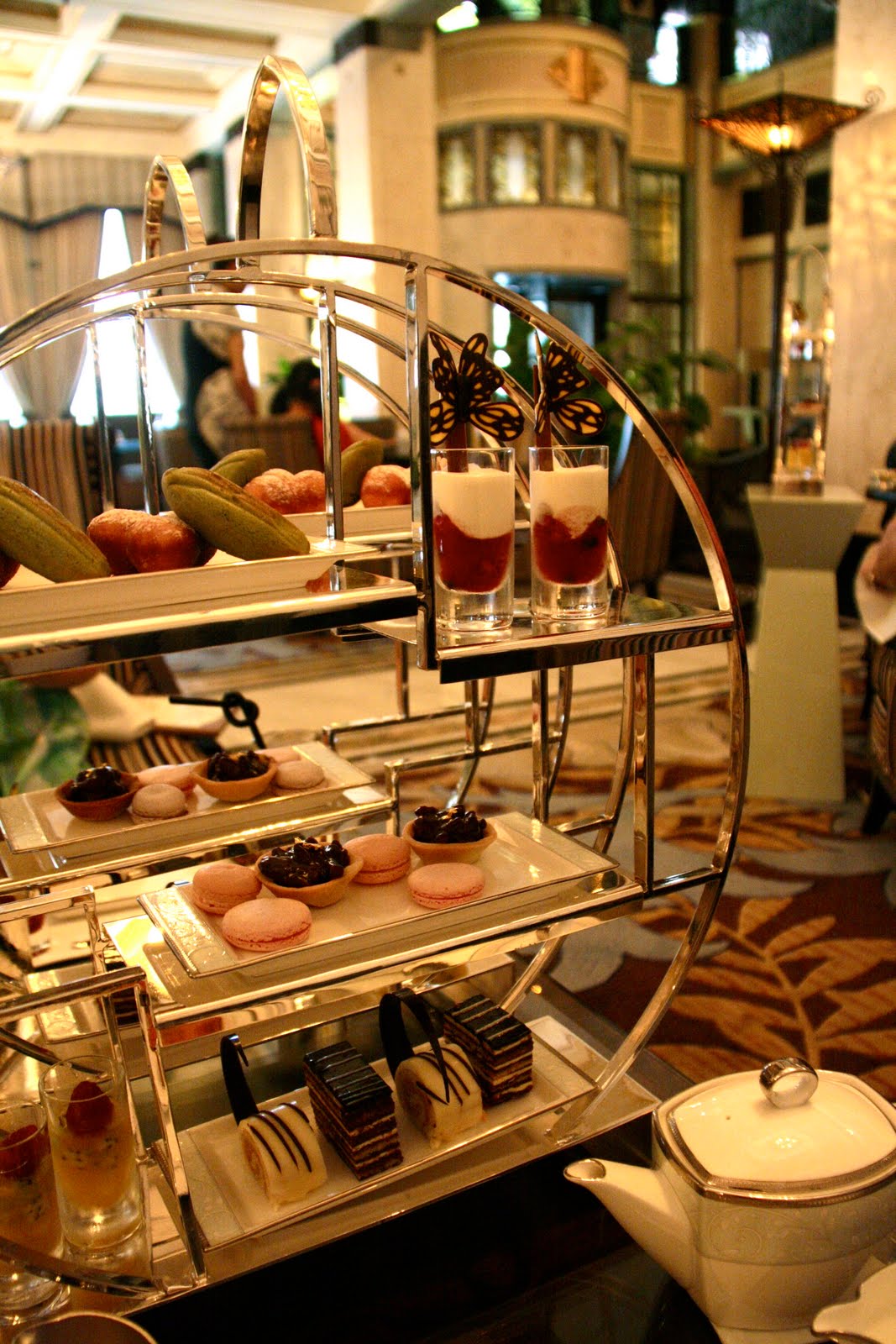
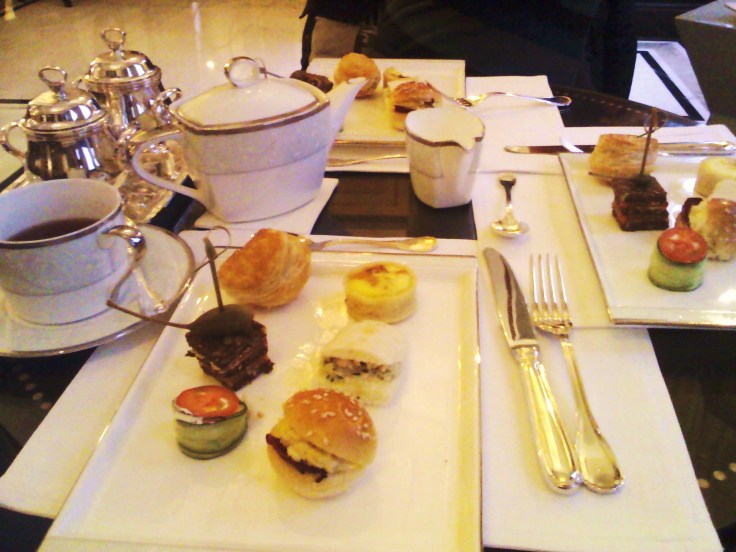
The gorgeous high tea experience
 
Yesterday, I ended tour at the Peace Hotel with a lovely British couple – Michael and Adrienne, they have been married for 49 years. Adrienne’s eyes lit up when she discovered that it is still the high tea time in the hotel’s Jasmine Lounge. In her words, it is the perfect way to recalling Shanghai’s ‘Paris of the Orient’ and its fame for having introduced European high tea to the city in the 1930s.
 
It was a lot for tea, can’t find any space for dinner afterwards
 
To me, I could never resist good food and it is wonderful to have British people confirming that the quality of the high tea in Shanghai is as good as what they have in London. The other thing is that you don’t really have to dress up to enjoy it 😉

From Steelmaker to Pig Farm

Pigs are HOT in China, and they are in demend…so one thing I could assure you is that Shanghai do have a lot of left over singles but we really don’t have any left over pigs, when they are ready to go, we want them. 

This week in China, one of the world’s leading steelmakers, Wuhan Iron and Steel Corporation (WISCO) or (武钢集团), recently announced plans to build a 10,000-head pig farm as part of a strategy of company diversification. WISCO was China’s first supergiant iron and steel complex. Annually, the company produces ten million tons of iron and steel each. According to the plan, they will invest 39 billion yuan in pigs/chicken/veg farms in 2012. 

Is this a JOKE?

Steel is cheaper than pork. The price of steel is said to be average 4.7 yuan per kg, far less than the 26 yuan price of pork.

A common saying in the company lately is, “Making steel is not as good as selling pork.” Energy and raw materials are rising and steel prices are down. Due to the lack of iron ore resources and the increase in the costs of distribution, the company saw annual sales fall to 230 billion yuan and profits to 3 billion yuan in 2011. 

The days of relying on massive scale and waste of resources is over

The company’s chairman, Deng Qilin, says the decision to build a pig farm is part of a broader restructuring plan to diversify the company away from its focus on steel. Deng says the cost of steel production is going up while the demand for downstream products like cars is down.

The company plans to set up a modern household service company that will provide all sorts of services, from buying houses to renting cars to children’s education to changing light bulbs. They also have plans for real estate and other manufacturing. Last month they signed a joint venture agreement with Hong Kong’s China Resources Group to produce natural gas. 

Deng says Wuhan Steel’s next step is to buy several thousand mu of land to begin “ecological” production of chickens, hogs, and vegetables. They plan to sell “Wuhan Steel” brand vegetables.

Thoughts and Ideas

Nice try! Maybe it is time for me to stop guiding and go farming! But what if all of the Chinese steel companies started to build pig farms? People need to be more creative in business ideas.

The Vegetarian Tiger

In Shanghai, the vegetarian lifestyle is more popular than ever. I love organic and healthy veggie but I do eat everything that is well prepared and taste wonderful. So people like me maybe considered as “semi-vegetarians,” which usually means that they eat vegetarian most of the time but occasionally eat meat. Unfortunately, being “semi-vegetarian” is like being “semi-pregnant.” You either are or you aren’t. A more accurate term for semi-vegetarian eating habits is “flexitarian.” But if the person in the photo will cook for me, I’ll eat veggie everyday!!

You are what you eat! This ancient saying can apply so well on Lulu, who started to change her life style about 10 years ago due to many chronic diseases. She was suffering from so much pain that no doctor across the continents could help her. She met a Healer in Hong Kong who told her to stop eating meat if she wanted to be healed because by cultivating more bad karma does not help us to cure from the core, he said. She didn’t understand why but she stopped. 10 years gone by, she has not only cured her own physical sicknesses, but also helped many people around her as well. To her surprise, the impact of food indeed goes far beyond the physical body.

Learn to eat foods that bring long lasting health, beauty and happiness
Sometimes you meet people and click right away, this is what happened to me when I met this famous happy chef, who has some amazing energy around her. She is so much into the energy of the food that she has chosen to follow the ancient yogic food philosophy, which encourages people to consume mainly sattvic food (vegetables [except pungent], fruits, nuts, grains, gentle herbs and spices). By following this philosophy Lulu has developed unlimited amount of fusion cuisines, she presents me a variety of tasty food that I didn’t even realize I wasn’t eating meat, milk products and pungent food at all! By eating the sattvic food, Lulu calls it “Joyfood” because these foods can give us long lasting health, beauty and happiness if we practice hard enough. Long lasting GAIN of course comes from long lasting PAIN, most people have no endurance, this is the major problem of her pupils, Lulu said. That’s why Lulu organizes private dinner with live music, so the people can at least experience momentary long lasting health, beauty and happiness in her Yogic Food Garden, she was laughing along this sentence.

The Whole World in one kitchen:
Lulu strike me as a Vegetarian Tiger, Soft outside but tough inside – that is what she is.  She is a language freak, speaks 6 different languages plus 3 Chinese dialects. But the richest side of her I guess it comes from her multicultural background – she is a funny mixture: she looks like a Chinese doll from outside, sweet and cute, almost like a kindergarten teacher, inside her the German system runs, yet from her core you can see and feel the Spanish fire.

When I asked her why she came to Shanghai, she said it was a call. If she could choose, she rather goes to somewhere warmer. Taking as her mission to incorporate the best organic supermarket concept from Germany (Alnatura) she is now helping her friend who owns 13 organic chain stores in Shanghai Haikele (HiQuality), helping them to upgrade to the international standard, meeting the latest health trend, allowing herself to shop the whole world in one single go.

All great things start from a simple idea

All the wonderful things in Lulu’s life came from changing what she puts into her mouth. Now that she is leading a life according to the Buddhist and Yoga teaching, together with lots of art and music, all she wants to do is to pass on this simple happiness to those who are searching for it.

Wanna come with me to a “joyfood” tour? Taken at Lulu’s home: the Yogic Food Garden:

                 A nice cozy kitchen create nice food 

             Colorful salads        

The food is beyond words! Full of LOVE and ENERGY!!! This great lunch lasted 7 hours, my goodness….. danger of two creative hearts on one table.

w.e Musical Education Fund for Migrant Children:

 Ever since Lulu was a child she wanted to learn people but her parents didn’t have the money for that. She started her piano lesson at her teenage with her pocket money. Thanks for the joyfood, her musical talent sprouts, she improvises and composes songs as hobby nowadays. Therefore she wants to help other potential Lulu who might also have the same dream. Therefore she founded w.e musical education fund for migrant children shanghai. w.e has many interpretation, one of its is “wealth exchange”, it’s a “made in Germany” product, place of its birth. 10% of the Yogic Food Garden revenue goes to this fund, now they have one child learning piano. Right, Lulu has a lot of interesting ideas, this is just one of them, you got to meet her if there is a chance.

The Green Ball Dumplings

My friend Bobbie just asked me today about the strange green balls which are selling all over the Shanghai streets now 

What is it?

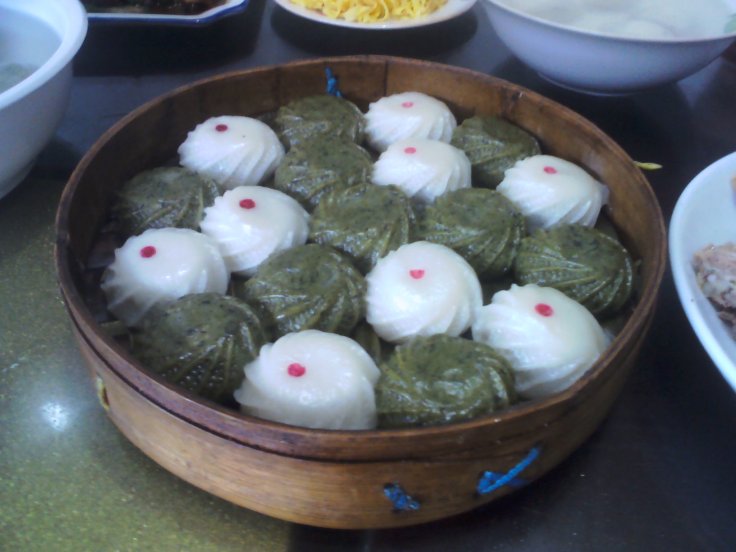
It is Qingtuan (Chinese: 青团, literally “green cake”) is a traditional Chinese dish. This food, which looks like a round green stone, is made of rice, red bean paste and a special plant called maiqing (麦青) (barnyard grass shoots) or aicao(艾草). The exact technique in making qingtuan is quite complicated. Barnyard grass shoots are edible only in spring, so this food is eaten for the annual Qingming Festival, which falls around April 5 in the Gregorian Calendar.

This is the look after you took a big bite, yummy~

The best green ball dumplings are made of Aicao, it is a special plant which is wildly used in China as a type of traditional herb medicine. So it is more expensive than maiqing, cost wise and people believe it is better in taste.

Step1: wash it and boiling

Step2:add glutinous rice and flour

Step3:mixing

Step4:make it into small little balls with red bean paste inside.
IMG_5068

Step5:steaming for 20 mins, ready!

IMG_5096

Quality  

I am picky with food, have to! Sometimes the poor quality balls tastes like Chewing Gum and the green color looks like fake paint – you don’t want to risk your stomach.  The best mass production ball dumplings are sold in Wangjiashao, go there and you will see a long waiting line, which is always a good sign for decent food.

張相片

Or you could go somewhere far, i.e. chubby feng makes amazing green balls.

張相片
 
Dough colored with wild herbs, homemade bean paste.
 
Chubby Feng's Qingtuan looks really fancy too!

The Dumpling Queen

Chubby Feng
Feng Wenhua, 52 years old, also known as "Chubby Feng," she was born into a poor family in remote Cungu Village in Fengxian District, a place where the land wasn't fertile.

You don’t choose a life, you live one. – This is what I learnt from the visit to Chubby Feng. 

Usually for a poor Chinese woman from the countryside, life is about helping the family, getting marry and raising children, anything but adventure. However, it is not the Chubby Feng case, she owns four small restaurants and operate one veggie farm in Pudong Fengxian area. In her own words, it is time to enjoy the good life. 

How did it happen? 

At an young age, she is like a BOY. Brave and never afraid of competition. Once there was a contest where all of the kids in her village was competiting to throw rice bags, the one who throw the farthest, would win a pretty bamboo basket. After the boys throw their bags, she simply walked backwards from the line and RUN to throw it….

Of course, Chubby Feng won and looked so happy that you can still feel that moment with her together when she was talking about this story. 

Daughters are usually not so important in the remote areas of China, so Chubby Feng did not get much education and worked at a local factory. At that time, she makes around RMB30 per month, that’s what every worker makes. By the early 1980, China started to change under the great leader of Dong Xiaoping, business started to come back.

During the 80s, leaving the factory means give up the IRON BOWL – an iron bowl means a job that lasts for a life time. Feng decided to leave the factory and start her own street food stall. It was true that a street food seller makes a lot more money than the factory worker in the 80s.

She struggled for years. In winter she pedaled her creaky tricycle to sell pancakes and youtiao (deep-fried dough sticks) near the temple in the town center; in summer she peddled ice cream at the front gates of schools and kindergartens; they were frozen in her hand-made icebox insulated by thick cotton padding.

Later on Feng became the first person from her village who decided to rent a big farm and sell veg to the city people….all of the people in her village think she is stupid and not a good wife because she did not take good care of her son and obey her husband.

For 3 years, the weather has been bad, she did not make any money and losted money. One morning as she was driving her loaded truck to the food market, she had a collision and suffered serious injury. A leg was badly broken and she hurt her voice crying for help. The village people thought she was stupid and looked down at her, her husband blamed her for starting the business. She could not even give RMB5 to her son to let him watch a movie.

I remember that at one point of the meeting, I asked Feng: WHY do you keep doing this? You don’t have to work so hard? You could remain as a factory worker, and be a normal woman.

Feng’s face was sad for a while and she took sometime to think about it, but her answer was firm and strong: Because I can’t live the rest of my life by letting people think that I am a loser. I need to have business so I can provide a better life for my family. There are so many brothers and sisters in my family and my in-laws always looked down at us because we were poor.

People says that only one out of ten business will succeed, so what do we do? TRY 10 times! 

Feng tried 4 times in her life and she finally succeed. Once you arrives at Zhuanghang Town old street, you will see the sign of Chubby Feng restaurant. Her specialty is the local dumplings, i.e. Zhongzi, Qingtuan. She currently holds the district record for making rice dumplings – 29 in 18 minutes – and she’s a master of many traditional snacks.

Ones Life Must Matter

After Feng become successful, all of the person that knows about her changed their mind. They now think that she is a great woman, brave and smart. People from the small village also felt that if Feng can run a business and change her fate, they should also be able to do it as well.

Interesting, right? Just don’t give up if you have a dream.

Globalization to One Country

It is pretty strange but everyone around me has been talking about globalization and telling me 2012 is going to be a BAD year. The house price is slowly dropping in China, living cost is going up and the min. wage in Shanghai has just raised 15%. Same as most people, I wish that I could forcast the future and know how to fix the problem.

Inside Job is such a great film to help people understand what is happening and it teaches us that Nothing Comes Without Consequences. When China joins WTO in 2001, Chinese people have little to none idea regarding what is going to happen and how much of it will effect with our day to day life. If the real estate price in Ireland raised 100% is considered as abnormal, Chinese real estate price probably is MAD. The interesting thing is that the price is regulated and hugely depending on the Chinese Gov. policy. Everyone knows there is a bubble but policy maker turned a blind eye on it and think it is okay to ignore. In the end it is the mid-class and workers to pay and endure. 

In China, certainly things here are still manageable and people’s over all mood is still quite good and positive. But in Europe, looking at what is happening with Greece is worrying. UK decided to run away from the mess and Merkel as the Chancellor of Germany is telling people to cut costs and stop borrowing and lending money. But there is no creative solutions to really solve the problem, what we have so far is just a very bad cycle – cut costs -> lay off workers -> people stop spending money -> no business -> lay off more workers. This feels like the End of the World.

The Type A Personality

Lagarde’s nomination as the first female head of the IMF is a good sign since there are just too many type A guys in the money world and they become out of control. Watching the ENRON story of the smartest guy in the room feels like reading a science fiction story, very intriguing and hard to believe that this really happened.

Let’s ask ourself why the financial engineer who is building dreams is getting paid so much more than the real engineer who is building bridges. If the bridge broken, the real engineers will be jailed, but if the dreams turn into nightmares, who is responsible?

Chinese Soy Sauce

Back to just a year ago, if someone tells me that I will have anything to do with Chinese Soy Sauce, I will probably think that he is crazy. Now, not only I am providing the only soy sauce tour in China but also working with the factory to help them marketing their products. It is to my surprise that such good products could not compete will the mass production junks and people has so little access to know or buy healthy food. Tomorrow, the very first Slow Food tour to the soy sauce factory will start and following is some info about it.

History of Traditional Chinese Soy Sauce

Soy sauce is originated in China 2,800 years ago and spread throughout Asia. Red cooking or hongshao is the word for Shanghai cuisine. For centuries, the city’s culinary culture has been stewed, simmered, sauteed and braised in soy sauce, a brownish-red condiment with a rich fragrance. Soy sauce is a condiment produced by fermenting soybeans with Aspergillus oryzae molds, along with water and salt. After the fermentation, which yields fermented soybean paste, the paste is pressed, and two substances are obtained: a liquid, which is the soy sauce, and a cake of (wheat and) soy residue, the latter being usually reused as animal feed. Most commonly, a grain is used together with the soybeans in the fermentation process, but not always. 

The Manufacturing Process: Brewing or Chemical-hydrolyzation.

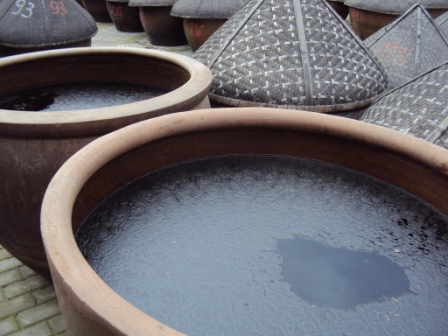
In older times, the mixture was fermented naturally in giant urns and under the sun, which was believed to contribute additional flavors. Today, in industrialized factory the mixture is generally placed in a temperature and humidity controlled incubation chamber. The fermentation method takes more than six months to complete and results in a transparent, delicately colored broth with balanced flavor and aroma. The non-brewed sauces take only two days to make and are often opaque with a harsh flavor and chemical aroma. In the current market, most branded soy sauce is often made from acid hydrolyzed soy protein instead of brewed with a traditional culture. When compared to brewed soy sauces, they have a longer shelf-life and are more commonly produced for this reason. They are sometimes called Chemical Soy Sauce by those who prefer brewed sauces, but despite this name are widely used due to greater availability and lower prices. Carcinogens have been identified in relatively recent times of Asian brands of Soy sauces. Some of these carcinogens may form during the manufacture of chemical sauce. Companies are obliged to remove these contaminants.

Chinese Soy Sauce types

Light or fresh soy sauce (生抽 shēngchōu ): It is the main soy sauce used for seasoning since it is saltier, less colourfully noticeable, and also adds a distinct flavour. The light soy sauce made from the first pressing of the soybeans is called tóuchōu (simplified Chinese: 头抽), which can be loosely translated as first soy sauce or referred to as premium light soy sauce. Touchōu is sold at a premium because, like extra virgin olive oil, the flavor of the first pressing is considered superior.

Dark and old soy sauce (老抽 lǎochōu), a darker and slightly thicker soy sauce, is aged longer and contains added molasses to give it its distinctive appearance. This variety is mainly used during cooking since its flavour develops during heating. It has a richer, slightly sweeter, and less salty flavour than light soy sauce. Dark soy sauce is partly used to add color and flavour to a dish after cooking.

Another type, thick soy sauce (醬油膏 jiàngyóugāo), is a dark soy sauce that has been thickened with starch and sugar. It is occasionally flavored with MSG. This sauce is not usually used directly in cooking but more often as a dipping sauce or poured on food as a flavorful addition.

Qian Wanlong: The Best Soy Sauce

Know as a famous old brand of “handmade” naturally fermented Shanghai soy sauce, Qian Wanlong. Qian was the owner in 1880 and wanlong means booming or prosperous. In 2008, the Qian Wanlong soy sauce-making process was listed as one of China’s Intangible Cultural Heritages – the only one in the industry. It is believed to be one of the few companies in China that still make soy sauce the traditional, old-fashioned way.

  •     Only Use non-GMO Soybeans
  •         12 Procedures in Production
  •     No Additives and Preservatives
  •     No Artificial Colours, No MSG

China’s Capitalist Revolution

Older Chinese are the ones who went through all of the changes in China during the past 30 years. Sometimes I wonder if they could believe that things can really change in such fast pace. One minute everyone wanted to join the army, work in the factory and proud of becoming a farmer, the next minute the same group of people want money, open business, buy LV and drive BMWs.

China’s Capitalist Revolution is an interesting movie on Deng Xiaoping’s reforms during the 80s. It tells the a gripping tale of the path that China took to opening up its economy, with plenty of anecdotes (e.g. the novelty of synthetic t-shirts), how people made a lot of money, but also how the changes created social unrest through corruption, inflation and unemployment…

From Chairman Mao’s little red book to Apple’s IPhone 4s in just 30 years and all these changes made China as one of  the most exciting countries in earth.

About this movie:

When Chairman Mao died in 1976, he left China in chaos and poverty. He was succeeded by Deng Xiaoping, who overturned Maoism and taught the Chinese to love capitalism, creating special investment zones for the West. But Deng’s crash course in capitalism went wrong when inflation grew and workers lost jobs. By 1989, China faced disaster. Now, 20 years after the tragic events in Tiananmen Square in Beijing, this programme reveals an interpretation of the motives of the demonstrators that may well overturn the conventional view in the West.  The demonstrators did not begin by demanding democracy. Corruption, inflation and the hardship caused by economic reforms drove students and workers to confront the government and the army. Students went on hunger strike, and troops killed more than 2,000. Deng Xiaoping gave the order to fire, but his ideas prevailed. This film argues that Deng’s capitalist revolution created today’s China.

The Opposite of Fate

Amy Tan is one of my favorite writer and I am so exited that she is coming to Shanghai for the 2012 Shanghai Literary Festival. The BEST thing is that I am going for the LITERARY LUNCH: Amy Tan in Conversation.

Her book of The Bonesetter’s Daughter was the very first English book which I read. It was almost 6 years ago and I clearly remember that when my friend Ashok gave it to me,  I was actually wondering how could I ever finish reading a book filled with so much English words. But later I carried the book with me and finished it during my holiday to the west part of China. After that, I realized it wasn’t that difficult to read English books and I really enjoy understand things from a different (western) perspective.

Amy Tan’s books are always filled with fascinating tales of mother and daughter relations, the ancient Chinese history and culture. As an ABC, she had no way to understand her mother’s hobbies and culture which seemed so different than Americans. Sometimes her story reminds me about the current life style change between the young generation who is born in the 80s and the older generation who is born before the 60s. 

In The Opposite of Fate, Amy Tan shares her insight into her own life and how she escaped the curses of her past to make a future of her own. She takes us on a journey from her childhood of tragedy and comedy to the present day and her arrival as one of the world’s best-loved novelists. Whether recalling arguments with her mother in suburban California or introducing us to the ghosts that inhabit her computer, it offers vivid portraits of choices, attitudes, charms, and luck in action-a refreshing antidote to the world-weariness and uncertainties we all face today.

Artisan Soy Sauce

Following is a really wonderful trip review from our client regarding her experience in visiting the Heritage Soy-sauce Factory

Shanghai is blessed with the only surviving hand-crafted soy sauce factory in the area, possibly one of the few left in the world. The Handmade Heritage Soy Sauce Factory which makes Guan Jiang Yuan soy sauce was started by the Qian Wan Long family over 130 years ago. Because it has been making soy sauce the same way for so many years it was awarded China’s “Historical Intangible Cultural Heritage” in 2008 which gives it certain protections and aid so that it can continue to operate and remain open.

You see, making soy sauce by hand as they do it in this factory is a long and slow process. As seems to be the case everywhere, soy sauce has fallen victim to mass production. A commercial company like Kikkoman can make a bottle of soy sauce in about 20 days. This place: about 2 years. It’s like the difference between a fine aged cheddar and Velveeta. They have to use a lot of “stuff” (chemicals) in Velveeta to try to get it to imitate cheddar, in a short period of time.

So what makes this company’s soy sauce so different? It’s the fact that it is allowed to age and ferment naturally, rather than doing it at lightening speed by chemical hydrolysis. Interestingly while we were tasting and comparing the handmade and commercially made soy sauces, I was smelling the artisan sauce and I suddenly caught a whiff of something that reminded me of cheese–that kind of yeasty smell.

The main ingredients, soybeans and wheat, are stored in this room. The very high threshold of the door is supposed to keep out rats

First soybeans are cleaned in the pot on the left, then soaked for 12 to 24 hours depending on the time of year.

Then they are steamed in this big contraption

The soybeans are spread out on this table and mixed with wheat, rice and what our guide called the “fungus”. I’m guessing it may actually be a yeast of some sort–perhaps yeast doesn’t translate easily from the Chinese. They use a bamboo scoop for mixing that you will see in a later picture.

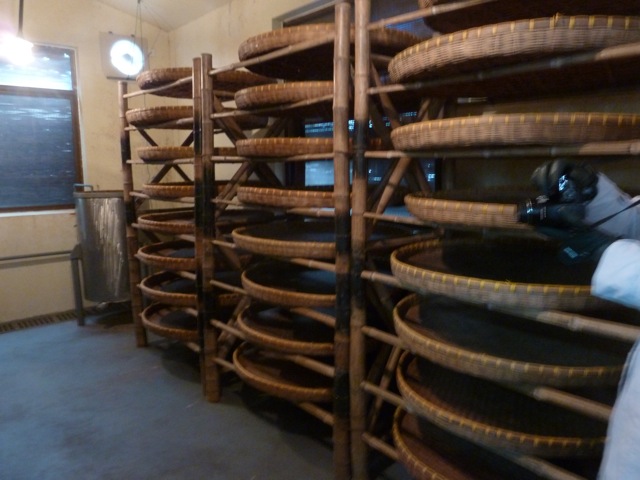
The soybeans are spread onto countless bamboo trays to allow the fungus to grow for about 5 days. This is a critical step as the fungus can be killed very quickly if the temperature goes too high in the rooms. The soy master often sleeps here to be sure the temperature is maintained appropriately.

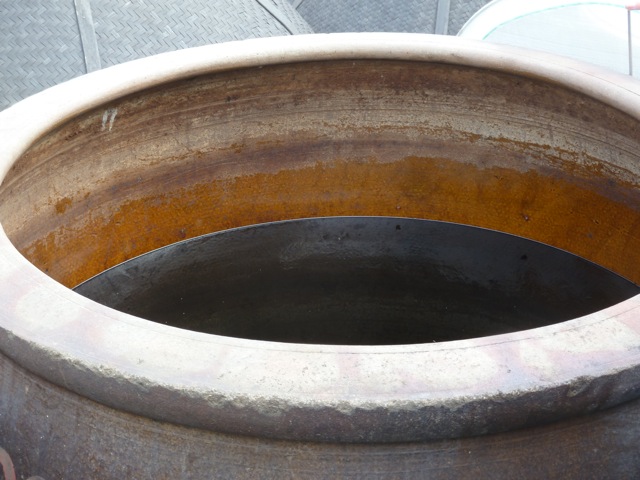
Salt water is then added to the bean and fungus mixture and the whole thing is put into these large clay pots with bamboo covers. Just like oak casks contribute to wine’s flavor, so too do the clay plots contribute to the flavor of the soy sauce.

The soy beans are left in the pots for at least year and stirred every 10 days. It’s at this point that the magic starts to happen. It’s because the pots are exposed to the 4 seasons and the changing weather and temperature that “interesting stuff” happens. Even the sun and the dew contribute to the taste of the soy sauce.

After a year or so, the mash looks quite a lot like something at the bottom of a pit toilet but smells just like soy sauce.
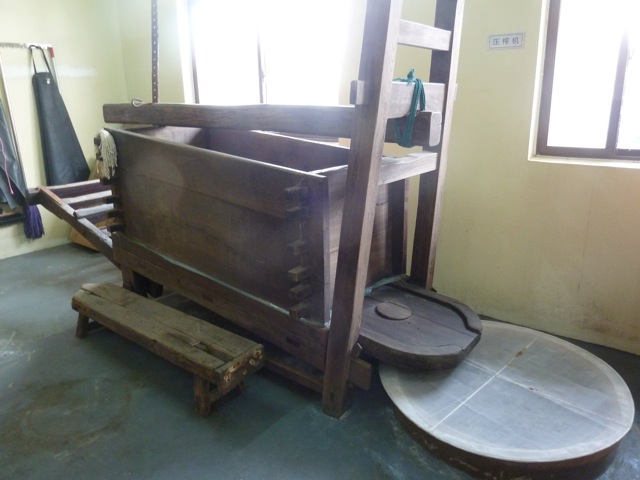
The mash is brought inside and squeezed out using this contraption. The run-off is collected and mixed with more salt water.

The leftover mash is used in two ways; to make another soy type product that I was unfamiliar with and to feed the pigs. There have been times in China’s history during periods of famine, when the leftover mash was used to feed people.

Back into the clay pots the liquid goes for another year for the sun and weather to work their magic. The soy master uses his 30 years of experience to decide when the sauce is perfect.

So the Kikkoman folks? They make up for all that natural sunlight and seasons and dew with msg and artificial colors and other, unpronounceable things. The Soy Factory only uses soybeans for the taste and wheat for the color and sweetness, and nature for all those undefinable flavors.

The soy master, in the middle, will tell you that his soy sauce has more anti aging properties than wine and that the longer it is fermented, the healthier and better tasting it is.

Perhaps there’s something to his claim, because Michael Pollan, author of “The Omnivore’s Dilemma” and guru of all food trends has just been to visit the factory as research for a book on the health benefits of fermented foods.

But there are a billion people in China and this little factory with it’s 400 clay pots can’t produce enough soy sauce for all of them even if they were willing to pay the 40rmb (6.30 USD) price per bottle for the 2 year old cheap stuff or the 200rmb ($32 USD) price for the 3 year old Rolls Royce of soy sauce. The factory workers are thrilled that they now have government support for their factory because they are so proud of the work they are doing and they think it is important to preserve the traditions they are keeping. They are hoping to extend their manufacturing base to other provences to recruit younger people who can keep the traditions alive as all the current workers are getting older.

However, they worry that because soy sauce making by it’s nature is a very slow and meditative process, that it will be boring and unappealing to young people. But, while it seems like a simple process, the soy master would tell you the subtleties of conditions like weather and temperature, make it anything but easy and knowing when a batch of soy sauce is ready to be bottled is the same as knowing when a wine will be in full bloom.
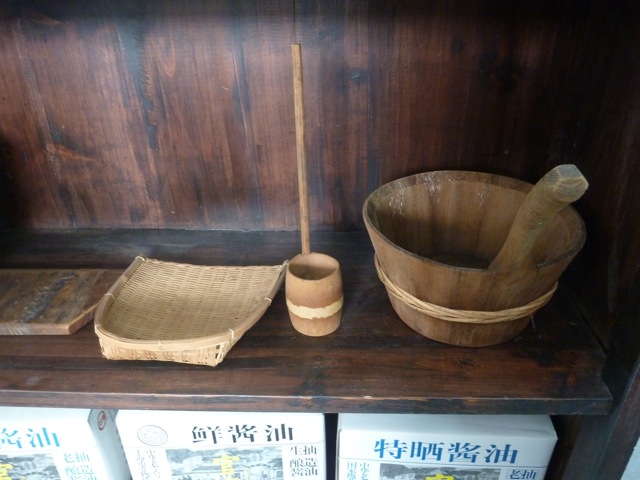
These are antique implements once used in the factory: the bamboo scoopers on the left, to mix the soybeans and fungus, and a ladle that measured out exactly 250ml for customers who were buying the soy sauce

This was the barrel the soy sauce was originally sold from. Now days it’s sold sealed in glass.

This is a priceless Chinese relic, the only one left in China: It is the imperial permit or license to open the soy sauce factory from 130 years ago, necessary because of the large quantities of salt required for production.

All the rest of these licenses were destroyed during the Cultural Revolution, along with all things considered “imperial”, but this one was saved quite by accident. It is made of a very good wood, probably ginko, and a carpenter saw it and wanted it for its wood. So he took it down and hid it in his shop and no one ever found it, thus saving it from destruction.

So, yes this soy sauce is great. There’s just one catch. You can’t buy it. Or maybe you can, once a year at one grocery store in Shanghai, if you happen to know which one and happen to see the line snaking out the door. Otherwise you’re out of luck. They actually bottled some just for us, so we were able to buy some. And only one restaurant, other than their own uses it in their cooking. It just seems a shame that if this is supposed to be such a superior product, it’s actually not available. We were all ready to volunteer some marketing advice to these people!

We were told that as part of our tour, we would get to sample some foods to use with their soy sauce. I guess the Chinese idea of sample and the Western idea of sample are two different things:

We were brought to their restaurant which is in the old factory building

Turnips in soy sauce

Tofu
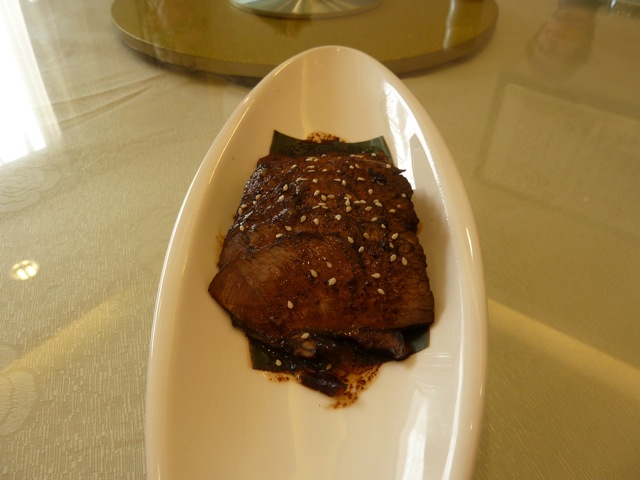
soy sauce beef

White cut chicken–mostly bones and skin
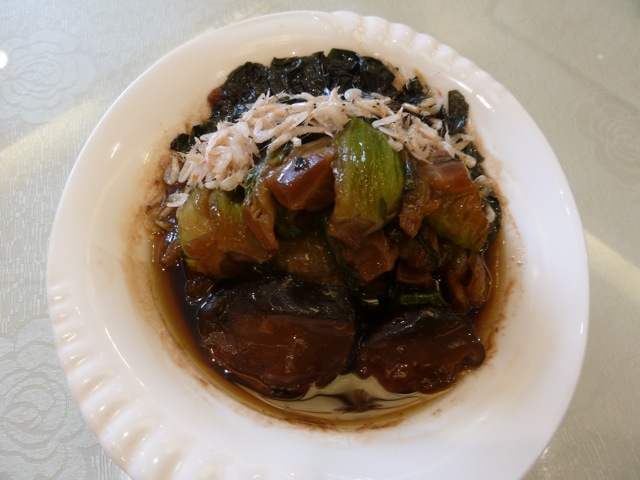
A shanghai-ese specialty dish, Pudong version with vegetables

tofu skin with vegetable and meat

Sticky rice ball soup–the balls were filled with meat or a sweet bean paste. The insides were fine, but the exterior was a sticky mess. Quite unpleasant.
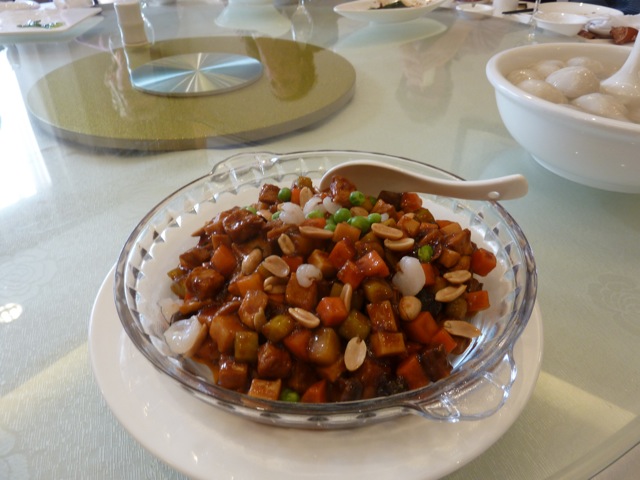
Eight treasures

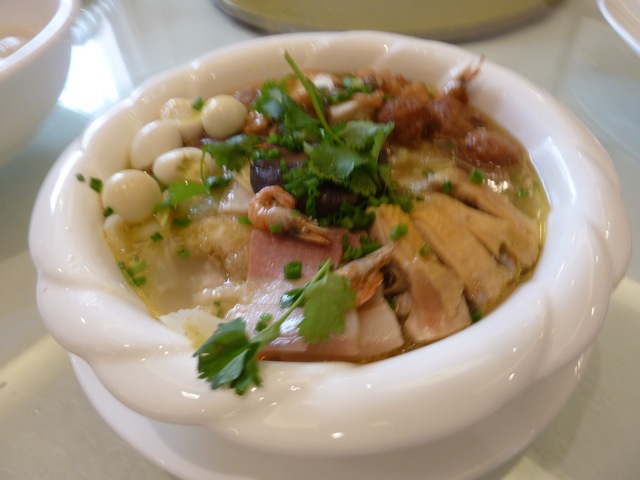
Steamed 3 flavor food, a local specialty. Includes quail eggs, pork, dumplings and pig skin. Nobody was too thrilled about the pig skin, but this dish was one of the most delicious of the bunch

ham, bamboo and pork soup: the fancy tower was toppled with chopsticks and stirred to make the soup

Hairy crab. Thankfully we were told we didn’t have to bother with the crabs on top.

We just got to eat these yummy pasta-like bits underneath

duck soy sauce lion head. This very much reminded me of Thanksgiving stuffing, only better.

Green vegetables like only the Chinese know how to make them

Shanghai red beef–the dish I learned to make in my cooking class

fried dumplings

And to finish off the meal, a big old bowl full of pig skin. Amazingly, it was still this full when we left the table. Hmm…

Reblogged from DECRYPTKNIT: Knitter on the loose in Shanghai:

Nanjing Massacre

I decided to do a short overview sheet for an up-coming trip to Nanjing Massacre Museum on 14th Feb, and yes, somehow 38 people picked the most unusual event for the Valentine’s Day. 

The Nanking Massacre or Nanjing Massacre, also known as the Rape of Nanking, was a mass murder, genocide and war rape that occurred during the six-week period following the Japanese capture of the city of Nanjing (Nanking), the former capital of the Republic of China, on December 13, 1937 during the Second Sino-Japanese War.

Timeline:

  • Aug 1937, Japanese army invaded Shanghai, Nov 12 Shanghai was captured
  • Nov 22 – The International Committee for the Nanking Safety Zone is organized by a 15 foreigners to shelter Chinese refugees, area of 3.86 km², with 25 refugee camps  
  • Dec 1, capital relocation–Chiang Kai-shek left Nanjing on Dec 7
  • Dec 5, prince Asaka appointed as commander and issued an order to “kill all captives”
  • Dec 9, Japanese army arrived outside of Nanjing urging the surrender within 24 hours
  • Dec 10, no response was received from the Chinese by the deadline
  • Dec 12, general Tang Shengzhi retreated, 100.000 untrained soldiers defending Nanjing
  • Dec 13, Nanking fell to the Japanese by nightfall, six-week period of Nanjing Massacre, Japanese troops engaged in rape, murder, theft, arson, and other war crimes
  • Dec 14, The International Committee for the Nanking Safety Zone lodges the first protest letter against Japanese atrocities with the Japanese Embassy
  • Dec 18, General Iwane Matsui knew the rape, murder, and looting in the city
  • Jan 1938, the Japanese army forced all refugees in the Safety Zone to return home
  • Feb 18, 1938, the Nanking Safety Zone International Committee was forcibly renamed “Nanking International Rescue Committee”, and Safety Zone effectively ceased to function.
  • Feb 19, 1938 – The last of the 69 protest letters against Japanese is sent by the Safety Zone Committee to the Japanese Embassy
  • Late March 1938, the end of the massacre
  • May 1938, the last refugee camps were closed
  • Mar 10, 1947, Hirohito and Matsui was prosecuted, prince Asaka got immunity

DEATH: Nanjing Massacre total death of 300,000 Chinese.

RAPE: 20,000–80,000 women were raped, including infants and the elderly.

Sara Imas – a Jewish woman’s amazing life in Shanghai

When I met Sara Imas, I was immediately amused by her high engery level and felt that she has so much passion about life and people in Shanghai.  The more I gets to know her, the more suprises I got. 

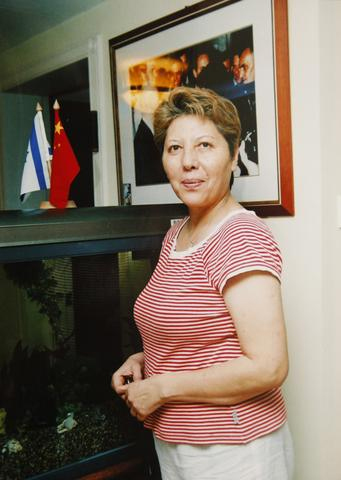
Sara’s father Leiwi Imas was the President of Shanghai’s Jewish Club. In 1939, at the age of 43,  to escape Adolf Hitler’s holocaust, Leiwi arrived in Shanghai among the more than 30,000 other displaced Jews that floated into the city between 1937 and 1939. With no money in pocket, he sold his only gold watch and opened a small bakery on the city’s French concession.  By the 1940s  he owned a dozen businesses, including two bakeries, three wine shops, a carpet shop and a truck-rental firm.  In Shanghai, he married to a Polish woman and had Sara as her only daughter.

Leiwi Imas chose to stay in China when most other Jewish refugees left after World War II.  At an old age, the businessman, customs officer and ex-president of the Jewish Club in Shanghai died peacefully in a downtown villa in 1962.

His daughter, Sara Imas, grew up among her Chinese peers without a Chinese passport, speaking only Mandarin with a local accent. After living through upheavals in Chinese history, including the “cultural revolution” (1966-76), and failing to find love despite three failed marriages to local men, in each of these three marriages, she had one child. With 2 teenage sons and one younger daughter, she migrated to Israel in 1991 at the age of 41 and made a living selling spring rolls.

Once there, the Jewish woman, who lacks a college degree, demonstrated an amazing ability to provide for herself and family:

She learned to speak fluent English and Hebrew, found a job in an Israeli court, sent her three children to Israeli colleges, returned to Shanghai 10 years later as the chief representative of a diamond firm to the Greater China area, and married a local government official. All of her 3 children also become very successful in life and business.

To learn more about Shanghai’s Jewish history, click here.

Chinese “Mating Ritual”: Explore Shanghai’s Marriage Market

This slideshow requires JavaScript.

According to a study from the University of Kent, in ten years China will have approximately 24 million unmarried Chinese men who cannot find wives. That’s more than the current female populations of Taiwan and South Korea combined, to give it some context.

However, in the big cities like Shanghai, there seems to be much more single woman than single man. They can be described as 3S lady – Single, Seventies, Stuck, or the SAS lady – Single, attractive, successful. 

You might wondering why these nice woman become the leftovers? It has something to do with the ABCD rule in Chinese culture, and this  is the secret behind everything:

A type means the best in the market, and it then follows with B, C, D types.

So the ABCD rule goes like that:

A man looking for B woman

B man looking for C woman

C man looking for D woman

Then you have A woman and D man, they are pretty hard to match, right?

Every Saturday and Sunday, at the Shanghai marriage market, parents, with or without their children’s consent, arrange meetings, dates and potential matches for their kids. Some children, often too busy working to devote time to meeting a soul mate, accept their parents’ help. But its not easy even for a parent, and many also employ matchmakers. 

Matchmakers broker meetings for numerous clients usually charging RMB 10-20 per pairing. “I’ve been a matchmaker for three years,” says Mr Zheng “There’s no large payment up front. If you get married, I expect a nice gift and maybe an invitation to attend the wedding. I already represent two American men. Interested?” Even then, matching people long term, especially with the famously strong-willed Shanghainese women, can be difficult. “I’ve been here a long time,” muses Mr Fu, a local matchmaker. “Girls in Shanghai are strong these days. Although they don’t have as much trouble finding a man, there are still lots of unmarried girls’ names on my lists.”

The history of the market started in 1996, by a small group of olderly people(less than 20 people) trying to help their kids, later on it was reported by the local media. Now by 2012, it is the largest one in China, with more than 1000 people attending in a day. 

Does it really work? A friend told me a true story.

A 29 years old lady does not have boy friend,  and since she is approching the Expiration Date, 30 in Chinese standard, her father worries a lot.

So on a Saturday, he went all the way to the marriage market, it took him 2 hours by bus because they live far from the city area. By the time he arrived there, the market almost finished. He rushed – almost run into the center, but accidentally he knocked a woman down.

Feeling sorry and embarrassed, he  apologize to her and naturely they had a chat. It turns out she had a son who is also 29 years old. So they agreed to let them meet.

Guess what? After 3 months, their son and daughter are happily married. More amazingly, one works as an accountant, another is a banker. I bet they enjoy counting money together.

Black Sesame Tang Yuan

The first month of the Chinese calendar is called yuan month, and in ancient times people called night xiao, therefore, the day is called Yuanxiao Festival in China. As the fifteenth day, it is also the last day of Chinese New Year.

Same as most people in China, today I rushed home after work and had Tang Yuan with family for dinner. Traditionally, Tang Yuan is served specially today, the pronunciation is similar to the word Tuan Yuan, which has the meaning of reunion and happiness. It comes many regional variations and many flavors ranging from bean paste filled to pork meat filled. My all time favorite are the ones with black sesame filings.

You need to eat Tang Yuan when it is warm – or better when it is HOT. The right way to eat it is picking up one soft and juicy tang yuan using a spoon. Take a tiny bit on the doughy skin. You can watch the sesame fillings rush out as the steam escapes from the inside at the same time. Use the tip your tongue carefully test out the fillings to make sure it won’t burn you alive. Once you are ready, go ahead and take a BIG bite or swallow the whole thing. Let the creamy juicy sesame fillings explode in your mouth as you chow down the chewy dough. Don’t stop here, reach out for the next one before I take it from you….

And yes, I had 10 of these for dinner today and felt really full…

Historically, a number of different names were used to refer to tangyuan. During the Yongle era of the Ming Dynasty, the name was officially settled as yuanxiao (derived from the Yuanxiao Festival), which is used in northern China. This name literally means “first evening”, being the first full moon after Chinese New Year.

In southern China, however, they are called tangyuan or tangtuan. Legend has it that during Yuan Shikai’s rule from 1912 to 1916, he disliked the name yuanxiao (元宵) because it sounded identical to “remove Yuan” (袁消), and so he gave orders to changed the name to tangyuan. This new moniker literally means “round balls in soup”.

When I was young, it was really fun make the Tang Yuan – to make the balls, take enough dough and roll into a ball, press it down with your palm, put a ball of sesame paste into the centre, gather the sides and pinch away access dough. Roll it to a ball. It is like making a toy and eat it later, so I always have to promise my mother that I won’t be naughty and play with the food.

The best place in Shanghai to taste Tang Yuan or buy the take aways is in Wang Jia Sha at West Nanjing Road, they are famous for it but keep in mind that the line is really long.

Venice of the East: Zhujiajiao Ancient Water Town

Qingpu is one of my favorite areas of Shanghai. Around ten years ago, it was known as the countryside area where farmers and fishermen lived, but according to local history, it is actually the origin of ancient Shanghai civilization.

Qingpu Memory

When I was a kid, a visit to Qingpu’s water town meant a fantastic weekend getaway; a perfect chance to forget the demands of school and concrete city buildings. Thoughts of the yummy local food and the beautiful village would excite me the whole night before the trip. I’d get myself ready and plead my mom to leave home as early as possible. After a long, half-day journey, we would arrive at the most famous water town, Zhujiajiao in the Qingpu area, to enjoy a lovely holiday.

Zhujiajiao Water Town 

These days, the road to Zhujiaojiao is really convenient – a 90-minute trip by car. People can escape from their busy, modern Shanghai life and step into traditional water town life.  You can take a boat tour along the beautiful rivers in Zhujiajiao and find yourself lost in ease. This water town was formed during the Song and Yuan Dynasty and was officially set up as a town during Emperor Wanli’s reign of the Ming Dynasty.

Other names for Zhujiajiao include “Pearl Streets Pavilion” and “The Pearl Stream.” The town occupies an area of 47 sq km and is crisscrossed by rivers and canals with nine long streets running lengthwise along the rivers. There are thousands of buildings of Ming and Qing Dynasty as well as thirty six ancient stone bridges. Among these bridges is a large ancient stone bridge called “Fangsheng Bridge” or “Setting Free Bridge” where you can purchase fish to release for good luck.

There are numerous long streets and lanes in Zhujiajiao. Among these, Great North Street boasts “a mile-long road with a thousand shops.” Kezhi Garden is representative of the architecture of the rich families from the area south of the Yangtze River. The ancient streets paved with stone slabs, deep and quiet alleyways, arched stone bridges, and quaint boats express the beauty of life on the water in the ancient town of Zhujiajiao.

Zhujiajiao’s Local Food

The traditional native foods include rose-flavored fermented bean curd, fried gluten, dark-rice zongzi dumplings, meat wrapped in leaves, roast soybeans, and pork meat zongzi. In autumn, people can have taste of the fresh water crabs from Dianshan Lake.

Zhujiajiao People

The development of Zhujiajiao has brought prosperity to its townspeople. The economy has become more developed, offering various job opportunities to them. More and more local families have started their own small street front businesses, selling such things as zongzi dumplings, pearls and various crafts. The main streets are slightly touristy, but most streets are still home to local residents, mainly elderly people and young kids. Doors are often left ajar, and little distinction is made between the house and the alleyway as people go about their day. Most people prefer to keep their old life style and continue to maintain their traditional lives in Zhujiajiao.

Qingpu Museum

Not far from Zhujiajiao, the Qingpu Museum offers a place for people to understand the culture and history of this area. The museum has a collection of approximately ten thousand pieces. The architecture, composed of five interlocking oval cylinders and constructed with modern architectural materials, looks like a flying butterfly. Inside the museum, visitors can easily learn the history of Qingpu and Shanghai. The Origin of Ancient Shanghai Civilization is the exhibition in the south wing of the museum. Starting with Shanghai’s origin, the exhibit shows the long history of Shanghai with beautiful archaeological finds from the Qingpu of Majiabang Culture, Sonze Culture, Liangzhu Culture, and the Maqiao Culture. Charms of Shanghai’s Water Culture is the topic for the display in the east wing. It covers the changes of water systems and construction related to Qingpu history. The models of Qinglong Town Port demonstrate the prosperous life and trade during the Song dynasty. Sections of Bridge Culture and Water Life vividly present the custom and folk culture of the local people.

Tips:

The ancient district of Zhujiajiao occupies approximately 3 sq km, and exploring it thoroughly will take you at least half a day – even more if you reserve some time for some of the numerous teahouses, coffeehouses, bars and restaurants. The best time to visit is on weekdays.

Years of Red Dust

I am a little bit obsessed with the stories in Shanghai, so during the quiet winter days, I just can’t help but read like a starved person for days. 

Qiu xiao long’s name was first mentioned from a friend’s email. He seems to be a really creative writer who is talented in telling mysterious murder stories which always happened in Shanghai and he is proud of mix famous Chinese poems into those exciting stories. Naturely I tagged his book as one of the most wanted in my reading list.
Surprisingly, Years of Red Dust fall into my hand as one of my Chinese New Years gifts.  Once I opened the pages, it connects me deeply and reminds me of my childhood time in the backsteets of the southern city. The warmth of the narrow busy lanes, the endless gossips on the other side of the thin walls and the smells of every day life, gosh, I missed it.

The name of this book inspired me to start a walking tour program in Shanghai – Years of Heavenly Light. It is a kind of lost memory for which was part of our life, sometimes dark, sometimes merry.  Next week, I will go back to that strange sad little place and try to capture the stories before every one forgets. 

The stories in Years of Red Dust trace the changes in modern China over fifty years—from the early days of the Communist revolution in 1949 to the modernization movement of the late nineties—all from the perspective of one small street in Shanghai, Red Dust Lane. From the early optimism at the end of the Chinese Civil War, through the brutality and upheaval of the Cultural Revolution, to the death of Mao, the pro-democracy movement and the riots in Tiananmen Square—history, on both an epic and personal scale, unfolds through the bulletins posted and the lives lived in this one lane, this one corner of Shanghai.

Learn Chinese Cooking – Fried Rice

“Have you eaten already?” is a popular greeting among the Chinese. Although it may sound awkward to westerners, when you meet local Chinese, it is one of the unavoidable first greetings. You might think, “Why do you ask me if I have eaten or not?” Perhaps you are wondering if Chinese people want to treat you for a dinner. Well, this sentence is just a polite way to start a conversation – the same thing as saying, “Hi or Hello” in English.

China is a country that pays great attention to courtesy, and the Chinese food culture is deeply rooted in its history. Confucius (551-479 B.C.) said, “The path to your friend’s heart and soul begins from your cooking.” Even now in modern days, dining is still a major “marketing event” to Chinese families, as it is a time when all the family members get together, share feelings and exchange information. Since meals are an important part of life in China, many important business deals are also done at the dinner table.   

Difference between Chinese & Western food

Cuisine in China is a harmonious integration of color, taste and presentation. The Chinese believe the following characteristics outline the basic differences between Chinese and Western food:

·         Several dishes in a meal

·         Diverse and sophisticated

·         Nutritionally balanced

·         Healthy and tasteful

How to cook

Cooking Chinese food is not difficult. The two most important tools in Chinese cooking are a hot stove and a sharp knife. Following the basic cooking rules below, you can master Chinese cooking and surprise your friends.

·         Balance the meat and vegetables in a dish, so that there are an interesting variety of flavors, textures, and colors.

·         Drain tofu before using, so it can absorb the other flavors in the dish.

·         Cut the meat into uniform pieces so that it will cook more evenly.

·         When adding oil for stir-frying, drizzle the oil down sides of the wok.

·         When deep-frying, determine if the oil is hot enough by simply putting a chopstick in the wok. When the oil sizzles around it, you can begin adding the food.

·         When a recipe says to add soya sauce, always use light soy sauce, not the dark one. Dark soya sauce is usually for cooking meat.

·         If preparing stir-fried meat and vegetables, stir-fry the meat first and set it aside. Normally, you will return it to the wok with a sauce during the final stages of cooking.

·         When stir-frying vegetables, cook the toughest and thickest vegetables for a longer period than the softer, leafy vegetables.

·         Always use fresh ginger, not powdered.

·         Use sugar as a substitute for MSG (Monosodium Glutamate).

Start with Fried Rice

Whenever I travel to visit friends, the simplest dish to prepare is Fried Rice – a dish that is always well appreciated. You can’t go wrong with the recipe and everyone can make it work! The following is a basic recipe for fried rice that you can alter to suit your taste.

Ingredients:

1 – 2 green onions, as desired

2 eggs

1 teaspoon salt

Pepper to taste

4 tablespoons oil for stir-frying, or as needed

4 cups cold cooked rice, or you can reduce the amount as needed

1 – 2 tablespoons light soy sauce or oyster sauce, as desired

Preparation:

Wash and chop the green onion. Lightly beat the eggs with the salt and pepper.

Heat a wok or frying pan and add 2 tablespoons oil. When the oil is hot, add the eggs. Cook the eggs by stirring until they are lightly scrambled, but not too dry. Remove the eggs and clean out the pan.

Add 2 tablespoons oil. Add the rice. Stir-fry for a few minutes, using chopsticks or a wooden spoon to break it apart. Stir in the soy sauce or oyster sauce as desired.

When the rice is heated through, add the scrambled egg back into the pan. Mix thoroughly. Stir in the green onion. Serve hot.

Tips:

If you like, feel free to add different vegetables such as tomatoes or potatoes. Remember to cut them into small bite-sized pieces, stir-frying the vegetables first, and setting aside for later mixing.

Create a free website or blog at WordPress.com.

Up ↑